Wednesday, 10 May 2017

CLEMENTINE: Signal to Jupiter Impact

Dark Side of the Moon is a French mockumentary by director William Karel which originally aired on Arte in 2002 with the title OpĂ©ration Lune. The basic premise for the film is the theory that the television footage from the Apollo 11 Moon landing was faked and recorded in a studio by the CIA with help from director Stanley Kubrick. It features some surprising guest appearances, most notably by Donald Rumsfeld, Dr. Henry Kissinger, Alexander Haig, Vernon Walters, Buzz Aldrin and Stanley Kubrick's widow, Christiane Kubrick.
Image result for 2001 a space odyssey earth moon
Related image

Clementine 1 - Lunar Polar Ice Discovery


Below is an unofficial logo, which highlights the Clementine rhyme about "a miner, 49er, and his daughter Clementine ... his shoe was #9". Note that the asteroid is in the logo, and the #9 is on the asteroid. Clementine also has a miner's pick shovel on her shoulder.

Image result for shoemaker shackleton crater clementine

Upstairs from the control room, Dr. Eugene M. Shoemaker, Clementine's chief scientist and a planetary geologist assigned to the project by the National Aeronautics and Space Administration, pored over the mosaics of pictures of such striking lunar craters as Tycho and Orientale Basin. The cameras, operating in different wavelengths and with an assortment of filters, were revealing sedimentary layers in the crater walls, he said, showing that the crust is not nearly as vertically homogenous as had been thought.
"It's beautiful stuff," said Dr. Shoemaker, who had spent much of his career analyzing earlier photography from the Surveyor and Lunar Orbiter flights, unmanned scouting expeditions that preceded the Apollo landings. "We will be able to identify rock types. Basically, we will re-do the geology of the Moon."
Because one of the mission's scientific objectives is to prospect the mineral content of the Moon, the spacecraft was given the name Clementine, after the miner's darling daughter in the old Gold Rush ballad.
Details of dark, deep craters at the polar regions were photographed for the first time. Several times the spacecraft transmitted special radio signals into the polar crater depths. The signals were deflected and received by antennas on Earth. Analysis of the modified signals is under way to see if they reveal the presence of any ice at the lunar poles, presumably deposited there by comet impacts and sheltered from sunlight.
Dr. Paul Spudis, deputy leader of the science team who is from the Lunar and Planetary Institute in Houston, said that ground-based observations had provided some tantalizing clues of possible polar ice. "If we do confirm the presence of ice," he said earlier in the mission, "it will be a very interesting -- if not major -- discovery."
Next Tuesday may 3, Clementine's rocket is to be fired to depart lunar orbit and head for a rendezvous at the end of August with a small asteroid, 1620 Geographos. On the way, the craft should be able to observe Jupiter as it is being struck by a cluster of cometary fragments in July. If fuel reserves remain high, said Dr. Donald M. Horan, a scientist for the Naval Research Laboratory, which built the craft, Clementine could continue to another asteroid rendezvous in October 1995.
After that, Clementine would be "lost and gone forever," another reason for its name.
Sdilogo.svgRelated image
Clementine does have an unusual pedigree. It was the idea of the Ballistic Missile Defense Organization, the scaled-down successor to the Star Wars organization in the Pentagon. Military engineers wanted to launch a spacecraft for testing new lightweight materials and electronics designed for "brilliant pebbles," the fleet of small space-deployed craft once proposed for intercepting and destroying missiles in flight.
http://www.nytimes.com/1994/04/26/science/cheap-moon-mission-may-offer-glimpse-of-future-for-nasa.html?pagewanted=all
On May 7, 1994 (UTC) Clementine experienced a computer failure after it left Lunar orbit.[4] The failure caused it to use up its remaining propellant, spinning the spacecraft up to 80 rotations per minute.[4] It was utilized in a geocentric orbit until the end of its mission, but the asteroid trip was aborted.[4]
Image result for 2001 a space odyssey moon jupiterImage result for 2001 a space odyssey moon jupiter
The mission spiraled out of control on the journey from lunar orbit to image the Jupiter-impact event named after Shoemaker, before an asteroid rendezvous. The mission however imaged the moon a few months before the Shoemaker-Levy 9 Jupiter event, making the symbolic discovery of the alien monolith on the moon pointing to Jupiter impact...(excavation for the Shoemaker monolith on the moon)

The two groups in charge (NASA/DoD) represent the monolith and signal as Shoemaker=Monolith and Star Wars/SDIO=TMA 1 Jupiter signal....

The mission failure in May 1994 coincided with the entry period of Jupiter ignition....
May 1994 Shoemaker Lunar mission impact
Image result for nasa clementine moon
May 1994 Shoemaker Jupiter impact
Image result for shoemaker levy 9
On May 7, 1994 (UTC) Clementine experienced a computer failure after it left Lunar orbit.
After flying near the Moon on 20 July 1994, Clementine went into solar orbit 
Two impacts 12 hours apart on July 19 created impact marks of similar size to that caused by fragment G, and impacts continued until July 22, when fragment W struck the planet.


Lunar Prospector is the third mission selected by NASA for full development and construction as part of the Discovery Program. The probe also carried a small amount of the remains of Dr. Eugene Shoemaker (April 28, 1928 – July 18, 1997), astronomer and co-discoverer of Comet Shoemaker-Levy 9, to the Moon for a space burial.

Shoemaker, a signal below the lunar surface pointing to Jupiter...

Image result for moon monolith
Image result for jupiter shoemaker comet
Image result for 2010 jupiterImpact Scar  Date: 16 Jul 1994 Overhead Projection of comet impact on Jupiter made by Comet Shoemaker-Levy 9, fragments "D" and "G".  Credit: NASA/Space Telescope Science Institute
Image result for 2001 monolith pyramidArthurCClarke 2010OdysseyTwo.jpg

Lunar spacecraft carries ashes, special tribute to Shoemaker

A health problem prevented Shoemaker from becoming the first geologist on the moon. Instead, he helped select and train the Apollo astronauts in lunar geology and impact cratering. He sat beside Walter Cronkite in evening newscasts, giving geologic commentary during the moon walks. He was involved in the pre-Apollo Lunar Ranger and Surveyor programs, and culminated his lunar research as science-team leader on the 1994 Clementine mission.
The Clementine mission included a deliberate search for water near the poles of the moon, Carolyn Shoemaker noted, but Clementine data did not settle the question. The search for water at the lunar poles is a key goal of Lunar Prospector, and that makes the tribute even more meaningful, she added.
https://www2.jpl.nasa.gov/sl9/news82.html

The Doppler Gravity Experiment (DGE) was the first polar, low-altitude mapping of the lunar gravity field. The Clementine mission had previously produced a relatively low-resolution map, but the Prospector DGE obtained data approximately five times as detailed: the "first truly operational gravity map of the Moon".[8]


Image result for NEAR Shoemaker

NEAR was the first spacecraft to touchdown on the surface of an asteroid.

On 14 March 2000, a month after entering asteroid orbit, NASA renamed the NEAR spacecraft NEAR Shoemaker in honor of renowned geologist Eugene Shoemaker.
And just as the follow up to Clementine (Lunar Prospector) carried the ashes of Shoemaker, the first asteroid rendezvous in 2001 was renamed Shoemaker, after Clementine's Jupiter-Geographos loss in 94...
Image result for monolith 2001
Image result for eros shoemaker 2001 a space odyssey
http://2p-encke.com/blog/2014/02/

Monday, 3 April 2017

Fenix DESTINI: Discovery of Atlantis

Image result for the core destini

DESTINY IS(I)S  Module "DESTINI" (Deep Earth Seismic Trigger INItiative)
Image result for sts 98
   

Osiris rising from the underworld via the Shoemaker/phoenix underground:
Image result for eros shoemaker green slime
Shuttle Atlantis deployed "Destiny" during the NEAR landing on Eros


In these myths Phanes is often equated with Eros and Mithras and has been depicted as a deity emerging from a cosmic egg, entwined with a serpent. 


Time, who was also called Aion, created the silver egg of the universe; out of this egg burst out the first-born, Phanes. Phanes was a uroboric male-female deity of light and goodness, whose name means "to bring light" or "to shine"; a first-born god of light who emerges from a void or a watery abyss and gives birth to the universe.[4]
Many threads of earlier myths are apparent in the new tradition. Phanes was believed to have been hatched from the World-Egg of Chronos (Time) and Ananke (Necessity or Fate) or Nyx in the black bird form and wind. His older wife Nyx (Night) called him Protogenus. As she created nighttime, he created daytime. He also created the method of creation by mingling. He was made the ruler of the deities and passed the sceptre to Nyx. This new Orphic tradition states that Nyx later gave the sceptre to her son Uranos before it passed to Cronus and then to Zeus, who retained it.

According to Aristophanes, whence he is called Eros, he was born from an egg created by Nyx and placed in the boundless lap of Erebus. After which he mates with Chaos and creates the birds.[5] This passage seeks to demonstrate that the birds are considered older than all other living creatures, even older than the other gods.
Image result for cosmic egg eros
               The 2001 Nisqually earthquake occurred at 10:54:32 local time on February 28, 2001.

Resonating "the dig", NEAR mission via shuttle Atlantis to a "phoenix underground" asteroid
The cover artwork for The Dig


The Dig

 A radio telescope in Borneo detects the approach of a large asteroid on a collision course with Earth; authorities dub it "Attila" after the ancient conqueror Attila the Hun. Scientists determine explosives planted on the surface of the asteroid may divert it into a stable orbit around Earth. A five-person expedition uses the Space Shuttle Atlantis to rendezvous with the asteroid and plant the charges. 
Low, Brink, and Robbins spacewalk to the asteroid and set the charges. While they are successful in altering the orbit of Attila, they find the inside of the asteroid appears hollow, and proceed to explore.When they enter a central chamber, they are trapped as the asteroid transforms into a dodecahedron pod and rapidly accelerates away into deep space. When the three recover and can exit the pod, they find themselves on an alien planet, on a central island surrounded by five smaller, spire-shaped islands; in the game's novelization, they name the planet Cocytus. 
Robbins insists they explore the structure separately and the two part ways, keeping in contact with their communicators. In what appears to be a museum, Low discovers a pair of crystals containing a glowing green liquid. After seeing a demonstration in the museum of similar crystals being used in what looks like a resurrection ceremony, Low tries one on Brink, bringing him back to life. They then search for a means to return to Earth, using Brink's and Robbins' talents for xenoarchaeology to decipher strange alien text and images.
Image result for the dig 1995
The Destiny module is the primary operating facility for U.S. research payloads aboard the International Space Station (ISS).[2][3] It was berthed to the Unity module and activated over a period of five days in February, 2001.[4] Destiny is NASA's first permanent operating orbital research station since Skylab was vacated in February 1974.
The Boeing Company began construction of the 16 ton (14.5 tonne), state-of-the art research laboratory in 1995 at the Marshall Space Flight Center in Huntsville, Alabama.[2] Destiny was shipped to the Kennedy Space Center in Florida in 1998, and was turned over to NASA for pre-launch preparations in August 2000. It launched on February 7, 2001 aboard the Space Shuttle Atlantis on STS-98.[4]

Image result for patches sts 98
NASA- mid Feb 2001, clearly Atlantis DESTINY and EROS were the headlines
The STS 98 Atlantis/Destiny mission landed on Feb 20, 2001, the same day "OSIRIS" was launched and  just a few days before the NEAR Shoemaker mission was unplugged, just hours after the "Fenix" seismic trigger event...
Image result for near shoemaker logo patchImage result for fenix underground seattle
Sts-98-patch.pngThis is the insignia for STS-98, which marks a major milestone in assembly of the International Space Station (ISS). Atlantis' crew will deliver the United States Laboratory, Destiny, to the ISS. Destiny will be the centerpiece of the ISS, a weightless laboratory where expedition crews will perform unprecedented research in the life sciences, materials sciences, Earth sciences, and microgravity sciences. The laboratory is also the nerve center of the Station, performing guidance, control, power distribution, and life support functions. With Destiny's arrival, the Station will begin to fulfill its promise of returning the benefits of space research to Earth's citizens. The crew patch depicts the Space Shuttle with Destiny held high above the payload bay just before its attachment to the ISS. Red and white stripes, with a deep blue field of white stars, border the Shuttle and Destiny to symbolize the continuing contribution of the United States to the ISS. The constellation Hercules, seen just below Destiny, captures the Shuttle and Station's team efforts in bringing the promise of orbital scientific research to life. The reflection of Earth in Destiny's window emphasizes the connection between space exploration and life on Earth.
Image result for sts 98 patch payload
STS 98 =Armageddon
Image result for sts 98 armageddonImage result for armageddon deep impact

The first mission to the earths mantle is taking place at the "Atlantis Bank" via "deep earth" seismic initiative going back to 1998!(Drill+Shuttle Atlantis=Armageddon)


Planned journey to the mantle of the Earth will break records

As part of the International Ocean Discovery Program, the scientists will use a ship, the Joides Resolution, to drill into an area of the Indian Ocean known as a mid-oceanic ridge, a line of deep trenches, mountains and undersea volcanoes where the crust is the thinnest in the world. The ocean here is about 700 metres deep.
"For decades, we thought the ocean crust was very uniform in thickness and therefore in structure," Professor MacLeod said. "We have reason to believe it is not – and our research findings are likely to confirm that."
Australian geologists are excited about the project. "This project is like a supergiant biopsy," said Monash University geologist Associate Professor Steven Micklethwaite. "It could shake the world – not with an earthquake but with a profound shift in the way we understand the Earth."
Atlantis: A deep earth seismic initiative
 Image result for mantle drill joides
 Atlantis was a metaphor for the primeval underworld (the interior of the earth).
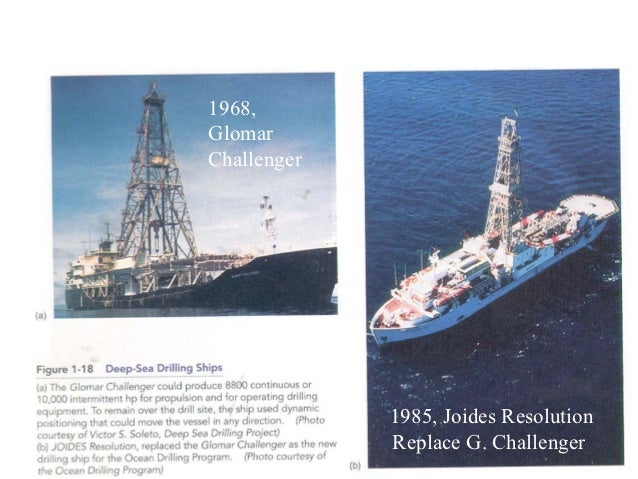
JOIDES Resolution (Joint Oceanographic Institutions for Deep Earth Sampling) is a scientific drilling ship once used by the Ocean Drilling Program, then by her successor, the Integrated Ocean Drilling Program (now known as the International Ocean Discovery Program). She is the successor of Glomar Challenger.
The ship was launched as Sedco/BP 471, an oil exploration vessel. She was later converted for scientific use and began working for the ODP in January 1985.
JOIDES Resolution returned to active service in February 2009 following an extensive renovation of her laboratory facilities and crew quarters.
https://en.wikipedia.org/wiki/JOIDES_Resolution

Deep Earth replaced Challenger one year before the Challenger disaster....
Image result for glomar challenger drill
Glomar Challenger was a deep sea research and scientific drilling vessel for oceanography and marine geology studies. The drillship was designed by Global Marine Inc. (now Transocean Inc.) specifically for a long term contract with the American National Science Foundation and University of California Scripps Institution of Oceanography and built by Levingston Shipbuilding Company in Orange, Texas.[2] Launched on March 23, 1968,[2] the vessel was owned and operated by the Global Marine Inc. corporation. Glomar Challenger was given its name as a tribute to the accomplishments of the oceanographic survey vessel HMS Challenger. Glomar is a truncation of Global Marine.

The fifth HMS Challenger (1858) was a screw corvette launched in 1858, converted to a survey ship in 1872 in preparation for her famous voyage, hulked in 1880, and sold for scrap in 1921. The research ship Glomar Challenger, the Apollo 17 lunar module and the Space Shuttle Challenger were named after this ship.
Image result for challenger 1986
The Deep Earth Challenger-Atlantis mantle connection is fitting since Challenger explosion= Set/Osiris descending to the underworld and Atlantis"underworld" launched the Destiny with the seismic "fenix"....   

"A Colombian Enterprise to Endeavor for the Discovery of Atlantis... and all Challengers shall be destroyed."


STS-26 was the 26th NASA Space Shuttle mission and the seventh flight of the orbiter Discovery. The mission launched from Kennedy Space Center, Florida, on 29 September 1988, and landed four days later on 3 October. STS-26 was declared the "Return to Flight" mission, being the first mission after the Space Shuttle Challenger disaster of 28 January 1986. 

STS-27 was the 27th NASA Space Shuttle mission, and the third flight of Space Shuttle Atlantis. Launching on 2 December 1988 on a four-day mission, it was the second shuttle flight after the Space Shuttle Challenger disaster of January 1986.

Discovery of Atlantis also followed the Columbia disaster:

STS-114 was the first "Return to Flight" Space Shuttle mission following the Space Shuttle Columbia disaster. Discovery launched at 10:39 EDT (14:39 UTC), 26 July 2005. 

STS-115 was a Space Shuttle mission to the International Space Station (ISS) flown by Space Shuttle Atlantis. It was the first assembly mission to the ISS after the Columbia disaster, following the two successful Return to Flight missions, STS-114 and STS-121. STS-115 launched from Pad 39-B at the Kennedy Space Center on 9 September 2006 at 11:14:55 EDT (15:14:55 UTC)


Space Shuttle Discovery also carried the Developmental Test Objective (DTO) 701B payload using Advanced Scientific Concepts, Inc.'s DragonEye 3D Flash light detection and ranging (LIDAR) sensor. The addition of the pulsed laser navigation sensor was the third time a Space Shuttle provided assistance to the commercial space company SpaceX, following STS-127 and STS-129. The DragonEye on STS-133 incorporated several design and software improvements from the version flown on STS-127 to provide increased performance. Its inclusion on STS-133 was part of a final  test run ahead of being fully implemented on SpaceX's Dragon spacecraft, which had its maiden flight in December 2010.[14]
Endeavour Atlantis Discovery
  Image result for sts 127 patchImage result for sts 127 payload patch

Image result for sts 129 patch
Image result for sts 133 patch
Image result for spacex  dragon eyeRelated image
The final shuttle launch was Atlantis(underworld fenix/Osiris) to be resurrected by the Dragon on the back of the Mars Falcon/Horus...
Related image

Image result for omega symbol
Image result for sts 135 patch
"Pad 39A is the same pad from which the Red Dragon mission will eventually blastoff atop a heavy lift SpaceX Falcon Heavy rocket – and which just reopened for launch business last week on Feb. 19 after lying dormant for more than 6 years since the retirement of NASA’s Space Shuttle Program in July 2011."


During first "Osiris REx" Mission:

Olympic torch unveiled in countdown to 2018 Games

(2018 Olympics kick off at "phoenix park")
Pentagram torch of Osiris unveiled just days after SB 51 torch
The 2018 Olympic torch is a special one--phoenix reignition ...
2014 "phoenix" torch reignited in 2018 symbolic of:
Image result for deep impact team deltaImage result for deep impact nasa
Image result for torch sochi  firebirdImage result for torch sochi pyeongchang
Feb 10, 2017
Falcon phoenix: